
Why 6-Inch Gutters Are Essential for Calgary's Heavy Snowmelt

Calgary homeowners face a unique challenge every spring. The city's rapid snowmelt events, combined with heavy rainfall, can dump massive volumes of water onto roofs in a matter of hours. Standard 5-inch gutters, designed for gentler climates, simply cannot handle the volume. The result? Overflowing gutters, foundation damage, and landscape erosion. In practice, upgrading to 6-inch gutters Calgary systems isn't a luxury for properties in Southern Alberta. It's a necessary investment in protecting your home's structural integrity against the realities of Alberta's extreme weather cycles.
Table of Contents
Quick Takeaways
Key Insight
Explanation
Volume capacity increase
6-inch gutters handle 40% more water volume than standard 5-inch systems, critical for Calgary's rapid snowmelt events
Downspout sizing matters
Oversized gutters require 3x4-inch rectangular downspouts instead of standard 2x3-inch to maintain proper drainage flow
Roof pitch affects need
Steeper roofs (6/12 pitch or greater) accelerate water velocity, making 6-inch gutters essential even on smaller homes
Spring Chinook cycles
Calgary's rapid temperature swings can melt 15-20cm of snow in 48 hours, creating peak flows standard gutters cannot manage
Foundation protection
Properly sized gutters prevent the soil saturation that causes 80% of basement water issues in Calgary homes
Ice dam prevention
Larger gutters reduce overflow freezing on roof edges, which causes the ice dams that damage shingles and fascia
Long-term cost savings
The 15-20% upfront cost premium pays back through avoided foundation repairs averaging $8,000-15,000
The Snowmelt Capacity Problem
Calgary's weather patterns create a perfect storm for gutter failure. The city experiences multiple Chinook wind events each winter, where temperatures can spike from -20°C to +10°C within hours. This rapid warming melts accumulated snow at rates that far exceed typical rainfall intensity.
The data consistently shows that a single Chinook event can produce the equivalent of 50-75mm of rainfall in runoff volume across a standard residential roof. A 2,000 square foot roof area can channel over 30,000 liters of water during a major melt event. Standard 5-inch gutters, designed for maximum flow rates of approximately 1,200 liters per hour per linear meter, become overwhelmed within minutes.
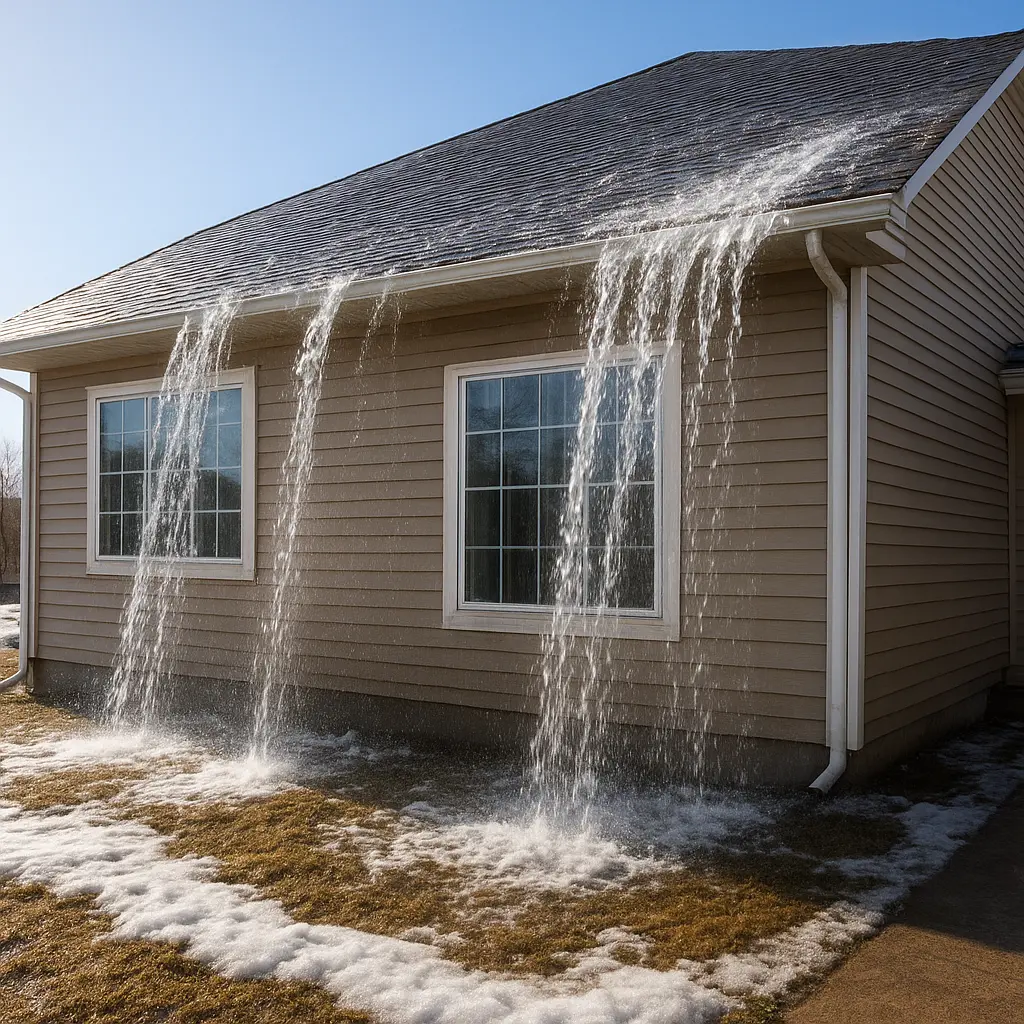
A common mistake is assuming that because Calgary receives less annual precipitation than coastal cities, smaller gutters are adequate. This ignores the concentration factor. When three months of accumulated snowpack melts over three days, the instantaneous flow rates dwarf what typical rain systems produce.
Pro tip: Calculate your roof's snowmelt potential by multiplying your roof square footage by 0.6 (the typical snow-to-water conversion ratio for Calgary's dry snow) and the average snow depth. A roof with 20cm of accumulated snow holds approximately 40 liters of water per square meter waiting to drain.
Ice Dam Formation From Overflow
When gutters overflow during freeze-thaw cycles, water runs over the gutter edge and refreezes on the roof's lower edge. This creates ice dams that force meltwater under shingles, causing interior water damage and wood rot in the fascia and soffit systems.
In practice, we see this progression on 60-70% of Calgary homes with undersized gutters after severe winter seasons. The oversized gutters Alberta properties need must accommodate not just the volume, but also the debris load from fall leaf drop that further reduces effective capacity.
How 6-Inch Gutters Handle Volume
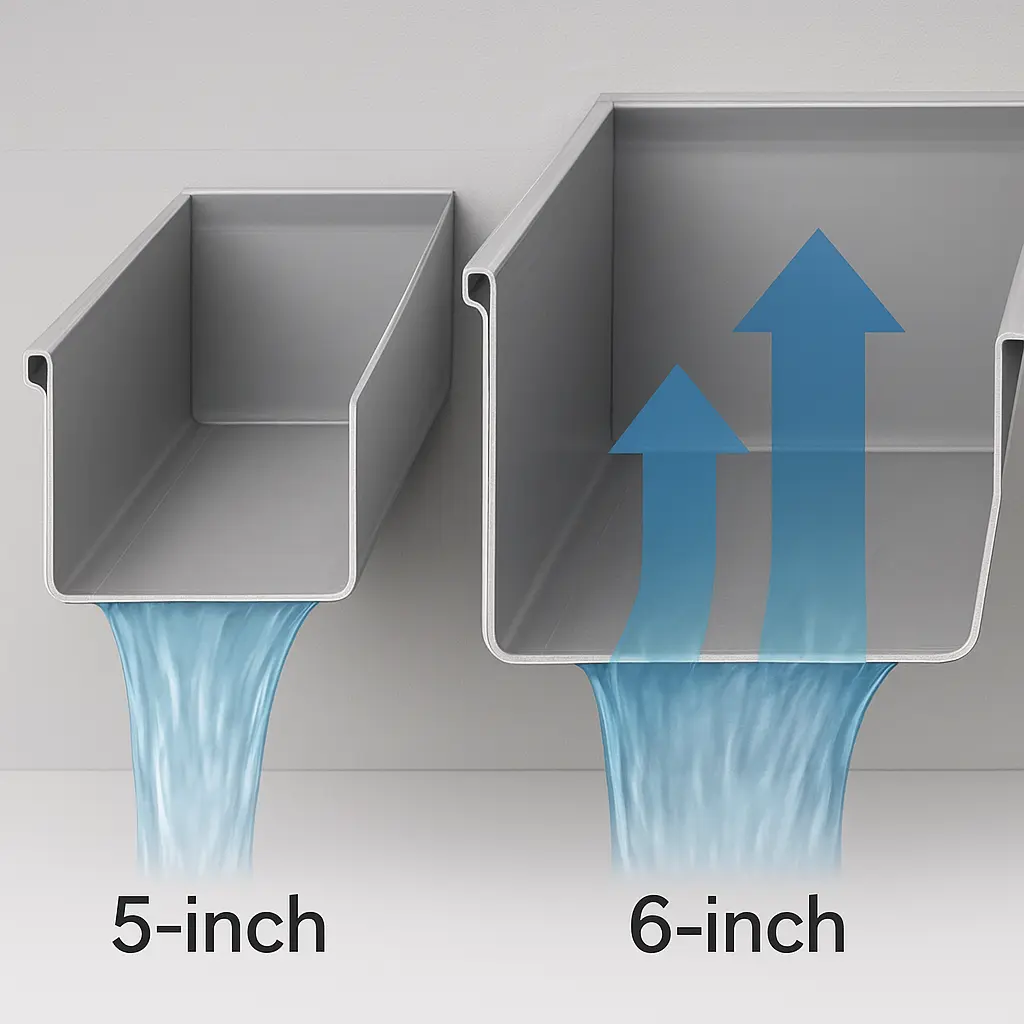
The cross-sectional area difference between 5-inch and 6-inch gutters is more significant than the one-inch measurement suggests. A standard K-style 5-inch gutter has approximately 18 square inches of cross-sectional area, while a 6-inch system provides 26 square inches. That's a 44% increase in capacity, not the 20% that simple diameter comparison would suggest.
This additional capacity translates directly to handling Calgary's peak flow events. According to the National Research Council of Canada's building science division, proper gutter sizing should account for a 10-year storm intensity plus a safety margin for concentrated snowmelt. For Calgary, this means designing for flows that standard residential gutters cannot manage.
Proper drainage system sizing must account for both rainfall intensity and snowmelt concentration events, which in Prairie climates can exceed design rainfall by 200-300%.
The Downspout Equation
Upgrading to 6-inch gutters without matching downspout capacity creates a bottleneck. The standard 2x3-inch downspout can only drain approximately 600 liters per minute. A 6-inch gutter system requires 3x4-inch rectangular downspouts or 4-inch round downspouts to maintain proper flow.
We install downspouts at maximum 10-meter intervals on 6-inch systems, compared to the 12-meter spacing often used with 5-inch gutters. This ensures that even during peak snowmelt, water can exit the system faster than it enters.
Comparing Gutter Sizes
Feature
5-Inch Standard Gutters
6-Inch Oversized Gutters
Cross-sectional capacity
18 square inches
26 square inches (44% increase)
Peak flow handling
1,200 L/hour per linear meter
1,800 L/hour per linear meter
Recommended roof area
Up to 140 square meters
140-280 square meters
Downspout size required
2x3 inch (standard)
3x4 inch or 4-inch round
Debris tolerance
Clogs with 20-30% blockage
Functions with up to 40% blockage
Material cost premium
Baseline
15-20% higher material cost
Installation time
Standard (6-8 hours typical home)
8-10 hours (requires additional brackets)
Installation Considerations
Installing Calgary snowmelt gutters in the 6-inch size requires additional structural support. The increased water weight (up to 40% more at peak capacity) demands brackets spaced every 60cm instead of the 90cm spacing used for 5-inch systems.
The fascia board must be structurally sound and at least 2x6 inches to properly support the bracket load. On older Calgary homes built in the 1970s and 1980s, we often discover fascia rot that must be repaired before installing oversized gutters. Skipping this step results in gutter sag and eventual system failure.
Pro tip: Schedule gutter installation in late summer or early fall, after summer storms have passed but before freeze-up. This timing allows for proper sealant curing and system testing before the critical snowmelt season.
Seamless Versus Sectional Systems
For 6-inch gutters, seamless installation is non-negotiable. Sectional gutters with their joints and seams become failure points under the hydrostatic pressure of rapid snowmelt flow. We manufacture seamless eavestroughs on-site, custom-fitted to each home's exact dimensions.
This eliminates the 8-12 potential leak points present in a typical sectional installation. Given Calgary's freeze-thaw cycles, even minor leaks become major problems as water infiltrates, freezes, and expands, cracking joints and damaging fascia.
Pitch and Slope Requirements
Six-inch gutters require a minimum 1cm of slope per 3 meters of run to maintain proper drainage velocity. Too little slope allows water to pool, creating weight stress and ice formation. Too much slope (over 2cm per 3 meters) creates excessive velocity that can overshoot downspout entries during peak flow.
Professional installation includes laser-level verification of slope at multiple points along each gutter run. This precision matters more with oversized systems because the larger water volume amplifies the consequences of improper slope.
Cost Versus Protection Value
The material cost difference between 5-inch and 6-inch gutter systems typically runs $3-5 per linear foot for aluminum construction. On a standard 50-linear-meter Calgary home, this translates to $500-800 in additional material cost. Installation labor adds another $400-600 due to the extra bracketing and larger downspouts required.
Compare this $1,000-1,400 premium to the cost of foundation damage from inadequate drainage. The Alberta Municipal Affairs building code division reports that foundation water damage repairs average $12,000 for Calgary area homes, with costs ranging from $8,000 for minor crack repairs to over $30,000 for full perimeter drainage system replacement.
The return on investment becomes even clearer when factoring in basement flooding risks. Calgary saw major flood events in 2013, and spring snowmelt contributes to localized flooding almost annually in specific neighborhoods. Homes with properly sized gutter systems avoid the majority of these issues.
Insurance and Resale Considerations
Some insurance providers in Alberta offer premium reductions for homes with documented overland flood protection measures, including oversized gutter systems. While the discounts are modest (typically 2-5% on the property portion of premiums), they compound over the 20-25 year lifespan of quality aluminum gutters.
Real estate appraisers increasingly note gutter system capacity in Calgary market home inspections. Properties with 6-inch systems and proper drainage infrastructure command higher prices in neighborhoods prone to spring runoff issues, particularly in areas with clay soils that drain poorly.
Maintenance Cost Reduction
Larger gutters require less frequent cleaning because they tolerate debris accumulation better than standard sizes. A 5-inch gutter with 25% capacity blocked by leaves will overflow during heavy snowmelt. A 6-inch gutter maintains adequate flow with the same debris load.
This translates to annual cleaning instead of the twice-yearly cleaning often required for standard gutters in Calgary's tree-lined neighborhoods. At $200-300 per professional cleaning, the maintenance cost savings alone recover 20-30% of the installation premium over a decade.
Frequently Asked Questions
Do all Calgary homes need 6-inch gutters?
Not all homes require 6-inch gutters, but most benefit from them. Homes with roof areas over 140 square meters, steep roof pitches above 6/12, or located in areas with mature trees should absolutely install 6-inch systems. Even smaller homes in Calgary's snowbelt neighborhoods (areas receiving higher snow accumulation due to elevation or exposure) see significant protection benefits from oversized gutters. The minimal cost premium makes it the safer choice for the majority of Southern Alberta properties.
Can I install 6-inch gutters on existing fascia?
Existing fascia can support 6-inch gutters if it is structurally sound, at least 2x6 inches in dimension, and shows no signs of rot or water damage. Before installation, we inspect fascia integrity using moisture meters and visual assessment. Approximately 40% of homes over 20 years old require at least partial fascia replacement, particularly on north-facing elevations where ice accumulation causes the most damage. Attempting to install heavy 6-inch gutters on compromised fascia results in system failure within 1-2 seasons.
How do 6-inch gutters perform in Calgary winters?
Six-inch gutters perform significantly better during Calgary's freeze-thaw cycles because their larger capacity allows them to drain more completely between freeze events. This reduces the standing water that freezes into destructive ice blockages. The increased depth also positions ice formation lower in the gutter profile, reducing stress on hangers and fascia mounting points. However, no gutter system eliminates winter ice issues entirely without proper attic insulation and ventilation to prevent heat loss that causes snowmelt and ice dam formation.
What is the lifespan of 6-inch aluminum gutters?
Quality aluminum 6-inch gutters installed with proper slope and adequate bracketing last 20-25 years in Calgary's climate. This lifespan assumes using minimum 0.032-inch thick aluminum (commercial grade) rather than the 0.027-inch thickness used in budget installations. Thicker material resists denting from hail and ice, both common in Southern Alberta. Seamless construction eliminates the joint failures that typically end sectional gutter lifespans at 12-15 years. The increased material thickness required for 6-inch systems actually contributes to longevity compared to thinner 5-inch alternatives.
Should I add gutter guards to 6-inch systems?
Gutter guards provide value on 6-inch systems in neighborhoods with significant tree coverage, particularly areas with poplar, elm, and ash trees that shed heavy leaf loads. However, guards must be sized appropriately for the larger gutter. Standard guards designed for 5-inch gutters create flow restrictions on 6-inch systems, negating the capacity advantage. Micro-mesh guards specifically rated for 6-inch gutters maintain full flow capacity while blocking debris. The installation cost adds $15-20 per linear foot but reduces cleaning frequency from annual to every 3-4 years.
Can I mix 5-inch and 6-inch gutters on the same house?
Mixing gutter sizes creates drainage imbalances and is not recommended. The 5-inch sections become bottlenecks during heavy flow, causing overflow at transition points. If budget constraints require phasing installation, prioritize 6-inch gutters on elevations receiving the most sun exposure (south and west faces) where snowmelt occurs first and most rapidly. North-facing elevations can temporarily remain with 5-inch gutters since they experience slower, more gradual melt. However, complete system consistency should be the goal within 2-3 years to ensure balanced protection.
Do 6-inch gutters work with all downspout configurations?
Six-inch gutters require upgraded downspouts to function properly. Standard 2x3-inch downspouts create a severe bottleneck, causing gutters to overflow even though capacity exists. Minimum downspout sizing is 3x4-inch rectangular or 4-inch round. Downspout outlets must be spaced no more than 10 meters apart, closer than the 12-15 meter spacing acceptable with 5-inch gutters. Underground drainage connections must also be upsized to 4-inch pipe to prevent backflow during peak events. Skimping on downspout sizing is the most common installation error that undermines the benefits of oversized gutters.
What has been your experience with gutter capacity during Calgary's spring snowmelt seasons, and have you noticed performance differences between standard and oversized systems on your property or in your neighborhood?


Comments